Studio Matters has been silent for several months. Permit me to say simply that this has been a hard season. Let me leave it at that.
How to reboot? Where to start? Interests and concerns pile up, like snowpack layers on a mountainside. It seems only courteous to bore into the consolidated mass with optimism, something upbeat and smiling.
But the ground under good cheer is unsteady. Allow me to forego the balancing act. If you would, let the words of Will Herberg set the tone. A convert from Marxism to Judaism, from the political left to the right, he told mid-twentieth century America much about itself:
Our modern world is as filled with idolatry as the world ever was. But our modern idolatry differs from the idolatries of the pagan world in a way more fundamental than mere difference in what we tend to idolize. Pagan idolators worship their idols directly and unashamedly; they know no higher law. . . . We, on the contrary . . . carry idolatry a step further.
We convert God himself into an idol, or rather, we make God into the sanctifier and protector of the idols we really love with all our heart and all our might. We speak of God and honor him, but the god we are really honoring, what is he but the god whom we look to [in order] to promote our interests and guarantee our ideals? Our modern idolatries are thus like the Baal practices of the Israelites in Canaan, modes of everyday life rather than explicit confessions of faith.
They are, perhaps, all the more dangerous on that account.
This passage from Judaism and Modern Man was written in 1951, in rage at the barbarities of the Nazi regime, a Völkisch cataclysm spawned in the heart of a supremely civilized Western culture. Three quarters of a century later, Herberg’s tocsin still resonates. Looking back, we recognize his warning now as prophecy: all idolatry is worship of the self.
Past is prologue:
In proclaiming as ultimate the ideas and programs to which we are devoted, we are but proclaiming the work of our minds to be the final truth of life. In the last analysis, the choice is only between love of God and love of self, between a God-centered and self-centered existence. Sin is egocentricity against theocentricity.
In effect, we ourselves are true gods on an Olympus of our own making—a summit of secular pieties and grandiose ambitions: social justice schemes; climate justice; net zero; open borders; sentimental humanism; holistic indigenous knowledge. The list is long.
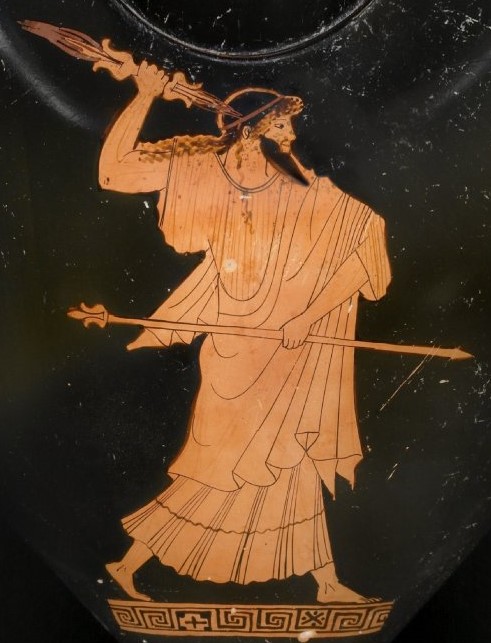
The Idolatry of Fixed Ideas
Idolatry—the idolatry of fixed ideas—is as rampant in the Vatican as in any other directorate. And just as dangerous. Even more so. Because the pope commands deference from the world’s peoples, the present objects of his worship—from climate change dogma to the antagonisms peculiar to an anti-Western leftist elite—disfigure the faith of billions. It becomes a golden calf festooned with gospel quotes. Even a bit of Latin. Or a lovely red mozzetta.
Donald Trump grasps the significance of Leo XIV’s election better than most Americans. On Truth Social last Sunday night he fired off: “If I wasn’t in the White House, Leo wouldn’t be in the Vatican.” That blunt indelicacy nettles. But it carries the weight of truth.
Leo’s first Easter Sunday oration exhibited a worrisome preference for ideology over moral clarity. It jabbed at President Trump—unnamed but, in context, the obvious target—for his actions in Iran. Two days later, Leo enjoined Americans to flood their congressmen with demands to end conflict with Iran. Next, the pope held a closed door meeting with David Axelrod, Obama’s hired muscle. A private audience with an American consiglieri signals strategic intent.
There is no longer any guessing the direction of this pontificate. The campaign against Trump in the coming midterms has just been launched from the Vatican.
Censure the President but Dialogue with Barbarians
Leo’s Easter address declined to acknowledge the consequences of an Iranian regime with nuclear weapons. Leo called for abandonment of “every desire for conflict, domination, and power.” He envisioned a utopian peace “not imposed by force, but through dialogue! Not with the desire to dominate others, but to encounter them!” In a parody of neutrality, he would not name the dominating force that has sought to extinguish Christianity—and all non-Muslim peoples and cultures on the planet—since the seventh century. His quarry was a sitting American president, not the bloodthirsty mullahs of Iran.
Dialogue! Encounter! Those were buzzwords of the previous pontificate, not the peace of the Gospel. America has been encountering the Islamic Republic of Iran for a half century. The peace promised by Christ passes all understanding because it is an eschatological pledge, not a schema for the end of global conflict. Jesus prophesied plainly: “Nation will rise against nation; and kingdom against kingdom.”
The sublime promise of the Resurrection is not as Leo phrased it: “. . . the resurrection reminds us that evil is not the last word, because it has been defeated by the Risen One.” His wording was off-kilter. Traditional understanding holds that Jesus’s resurrection testifies to the stunning reality that—despite earthly chaos—death does not have the last word. It is death itself that has been defeated.
Evil abounds. The ruin of souls must be given due credence. Without it, the concept of sin dwindles to what Thomas Mann called it in The Magic Mountain: “a half jovial, familiar, and mildly facetious word.” Fear of God disappears in a fog of comforting platitudes about love and leniency. Or, in Leo’s arcadian fancy: “respectful relationships at every level.” Even among nations.
Leo’s rhetoric can leave the impression that moral guilt would cease to apply if we simply aligned our politics with his. And with his denial of the existential divide between Western civilization and a theologically obligatory barbarism that does not yield to reason.
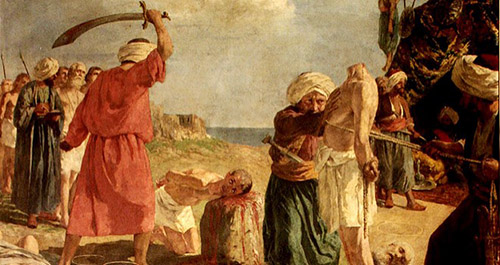
NOTE: See introduction to the beheading of Christians by Ottoman invaders in Otranto, Italy, in 1490. Also here.

