“Why pick on Francis now that he is dead?” That was Gavin Ashenden’s lead-in to his conversation with Peter Kwasniewski about Dominic J. Grigio’s The Disastrous Pontificate, a critical analysis of the Bergoglian era. The two theologians teamed up last month to examine Grigio’s analysis of consequential theological knots left from the reign of Pope Francis.
In sum, the reason to keep studying Francis is that he is key to the nature and direction of his successor’s pontificate. These are not academic issues. For those of us who are neither scholars nor “professional catholics,” a certain sorrow hangs over them.
Ashenden’s question triggered an old memory of Yevgeny Yevtushenko’s once-famous poem “The Heirs of Stalin.” It was written in 1962, soon after Stalin’s body was removed from the mausoleum in Red Square as part of Khrushchev’s de-Stalinization policies. Stalin’s remains were quietly reburied near the Kremlin wall and marked with a simple stone. (A bust was added later.)
The poem was a blistering alert that Stalin’s legacy, carried by his followers, was still dangerous. It asked: “But how to remove Stalin from Stalin’s heirs?” Yevtushenko imagined that Stalin was just pretending to be dead: “He was scheming; Had merely dozed off.”
He was far-sighted. Adept in the art of political warfare,
he left many heirs behind on this globe.
I fancy there’s a telephone in that coffin.
Those lines conjured up Francis’s continuing legacy—a posthumous bequest to Leo’s pontificate. Out of the starting gate, Leo pledged to uphold the patrimony of his “beloved predecessor.” Most Catholics took the promise at face value as a deferential gesture that held to Benedict’s earlier “hermeneutic of continuity.”
Traditional vestments! Return to the papal apartments! The Regina Coeli chanted in Latin on the loggia! These were welcomed as signals that a de-Bergoglianization was on its way.
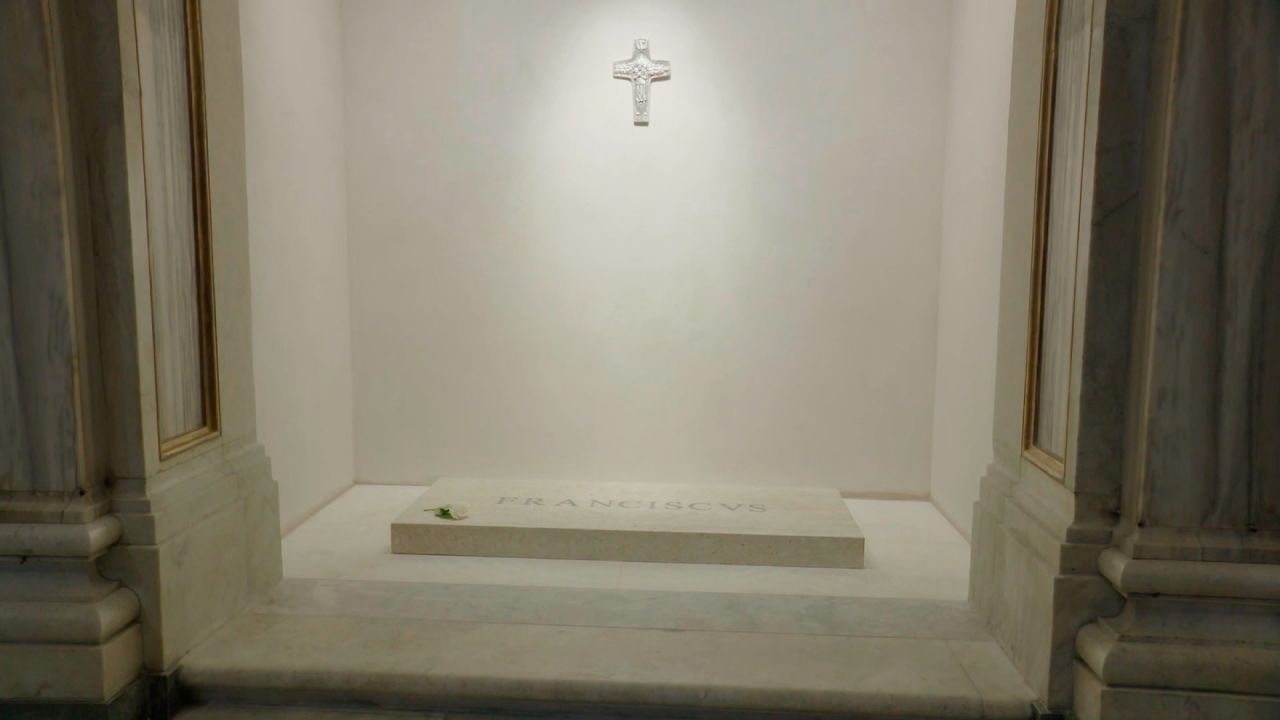
Now, one year after Francis’s death, his body remains in its niche in the Basilica of Saint Mary Major. But under that simple slab of Ligurian stone a concealed communications network transmits to the Vatican. Yevtushenko would understand: “From that coffin, where else does the cable go!”
Francis still lurks.
How to remove Francis from Francis’s heirs?
The Grigio book’s title sets the tone. Its subtitle—Pope Francis’s Rupture from The Magisterium—heralds examination of Francis’s departures from scripture, sacred tradition, and the Church’s enduring understanding of itself.
The Ashenden-Kwasniewski online discussion, “When the Pope (Francis) Becomes the Problem that Haunts the Church” deserves to be read in full.
For centuries, the papacy has been the instrument of clarity: the place where doctrinal disputes are resolved, where ambiguity is dispelled, where the faithful are confirmed in the truth they have received. But what happens when the centre speaks in a way that seems to invite interpretation rather than close it?
This is the question that occupies The Disastrous Pontificate. What concerns me here is its concentration on the use—and abuse—of language.
“First they come for the language.”
That was the response to my previous post from a man with an ear for cant and a cultural memory. He riffed on the opening words of a well-known post-war reflection by German theologian and Lutheran pastor Martin Niemöller: “First they came for the Socialists” . . . . So began Niemöller’s indictment of the cowardice of intellectuals and clergy in the face of Nazi ascendancy.
In our own day, Eros is rising. Our shepherds gather to finesse the ascendancy, not to counter it. Dialogue in this instance is a genteel evasion that permits eventual conciliation to pass without having to call it by its right name.
Language is at the very center of the challenge we face in the contemporary Vatican. My correspondent’s adaptation applies to the studied ambiguity employed by Leo and his synodaling confreres. They use traditional vocabulary—familiar religious phrasing—but carefully empty it of substance.
A recent instance was Leo’s touted rejection of “formalized blessing” of same-sex couples. Catholic media skimmed the cream from the surface and erupted with relief. There, you see! He’s one of us! He’s against blessing same-sex couples!
Not so fast. Formalized blessings are under wraps for the time being. But Fiducia Supplicans still stands. Unofficial, informal blessings are quite welcome. Expect to see more of them.
One thing we will not see—not until attitudes change, per Leo XIV—is any valid supplement to the rubrics, such as one already in casual use: Equal Rites: Lesbian & Gay Worship, Ceremonies & Celebrations. An explicit, canonically approved blessing for same-sex couples will not appear in liturgical texts just yet. Rather, Leo-appointed bishops—e.g., Málaga’s Bishop Antonio Satué— will tell us that blessing the sexual habits of same-sex couples is “a step forward for the Church.” The post-Christian dogma of inclusivity overrides that old command to “go and sin no more.”
Satué intoned: “Being homosexual is not a sin.” True. It is homosexual behavior, not inclination, that is deemed sinful. Doubtless, not all entries in Butler’s Lives were heterosexually inclined. Nonetheless, such saints were not “gay.” Their identity was rooted in the call to sanctity. Not in their libido.
But today’s forward-thinking prelate has a finger in the wind. Tracking the vibes, he declines to distinguish between a transgressive proclivity and the will to act on it: “We will have to find a way to better incorporate this undeniable reality [homosexuality] into our pastoral practice.”
He ignores the “undeniable reality” of the persistent range of sexual trespasses. Why cherry-pick only one from man’s long history of eroticism for admission to the embrace of pastoral practice?
It might not be immediately obvious, but Satué’s burlesque of moral reasoning applies equally to the undeniable reality of pedophilia. Might the synod path lead deeper into the peripheries of sexual culture to liberate pedophiles—and a restrictive ethos—from the oppression of age-of-consent bigotry?
Ask any civilized parent for an unambiguous answer.
• • • •
Degraded logic is persuasive if it sounds devout. Welcoming Eros—a primordial god self-formed at the dawn of existence—in from the cold begins with a soothing lie: that homosexuality is a “gift,” not a breech in social order or a counterfeit normalcy. If raising a perversion to the dignity of an endowment is the synodal way, then the hell with it.
• • • • •
A tincture of traditional piety disarms resistance to radical change. Catholics need to develop immunity to obfuscating eloquence.
Start with Leo’s rendering of signals from the phone in Francis’s coffin.

