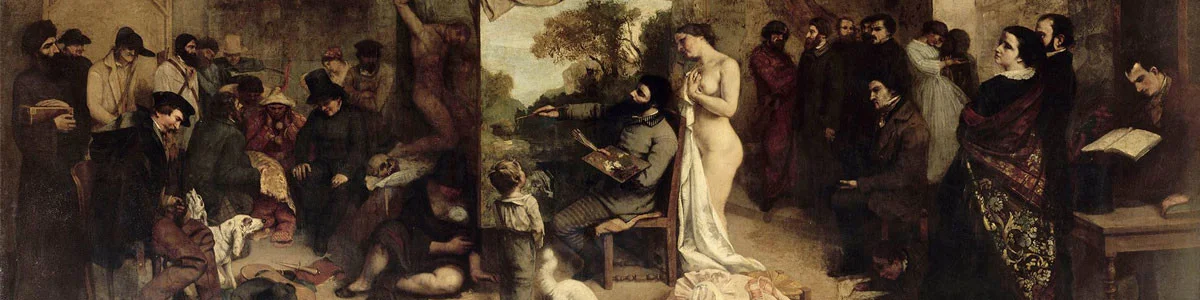
It is an odd thing, this culture of blogging. I am still not fully at home with it. The very word blog makes me wince. It is an ungainly term, ugly to look at on the page and even uglier to hear spoken. Gelatinous. The word comes dangerously close to blob . If I had to pick a visual correlative for the term, it could only be this: Somewhere in the pudding of phonetic associations, is blah and blab . Worse, frog —as Emily Dickinson used the word:
How public, like a frog To tell your name the livelong day To an admiring bog!
Continue Reading
The only Christian work is good work, well done. –Dorothy Sayers   Ask: “Who is the greatest figure painter of the late twentieth century?” The answer on this side of the Atlantic is likely to be Lucian Freud. Across the water, the choice is hardly so clear cut. Euan Uglow (1932-2000) is one of Britain’s most distinguished—to many, the most distinguished—painter of his time. Ten years younger than Freud, he died too soon. Uglow was an austere, luminous practitioner of direct observation. Continue Reading
Glancing quickly, I misinterpreted the opening lines of a recent bulletin from Sandro Magister’s Chiesa . My eye fell on a reference to the Venice Biennale and, at the same time, on a thumbnail image of a contemporary chapel. At once devotional and festive, it looked to be a lovely ensemble. My immediate impression was that the Vatican pavilion would contain a model chapel, a beautifully designed invitation to prayer—a challenge—addressed to the international art crowd. I was ready to recant all my misgivings about Cardinal Ravasi’s foray into the belly of the casino: I take it all back! Continue Reading
Among liturgically concerned responses to the previous post, one of them gave me a start:
On Corpus Christi, at a Manhattan parish, we had to sing an entrance song which begins, “We are here to tell our story, We are here to break the bread, we are here to know our rising from the dead . . . ”
Here to tell our story . The Gospel of Me. The all-encompassing Cosmic Me. The lyrics lend new meaning to the adjective catholic , do they not? Continue Reading
Today we hear conga drums, trap sets, bongos, and other drums played not in the style of Monteverdi processions, or Masses by Haydn or Mozart. Instead we hear them just as we would hear them in a bar or dance hall. They are used just as they are in the secular world: to keep a beat, to make the music groovy, to inspire us to kind of do a bit of a dance. That’s the association of percussion we have in our culture.
Continue Reading
Subscribe To The Newsletter

Subscribe To The Newsletter

Join the Studio Matters mailing list for an occasional heads-up. Thank you.

You have Successfully Subscribed!

Premade image 14

Subscribe To The Newsletter

Join the Studio Matters mailing list for an occasional heads-up. Thank you.
