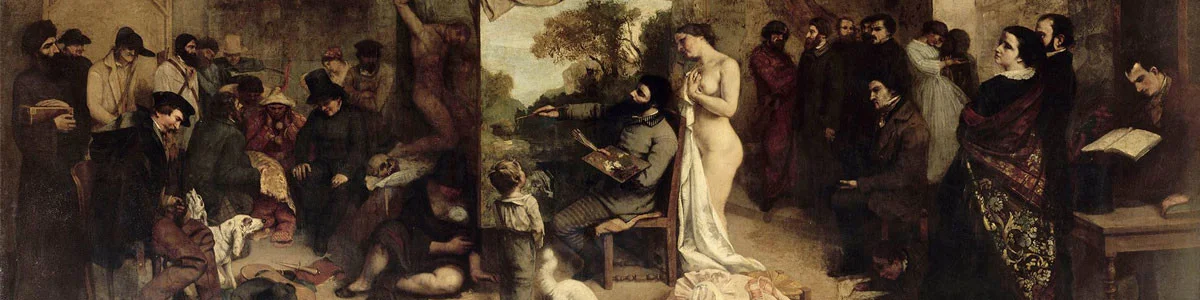
The trouble is that modern art in various ways abandoned imitation, representation, naturalism, and it now has to make out a case for its products’ still being truth. This is where science certain aspects of science are seized upon, assimilated, or sometimes simply plagiarized in decorative words, so as to bolster up art’s claim to cognitive value. One such use, and it is a curious reversal of Aristotle, is the boast of factuality: the work of the artist is said to be research; his creations are findings.
Continue Reading
It cannot be said that a man endures death easily or uneasily when he does not think about it at all. He who feels nothing, endures nothing. —Voltaire
When did I stop liking Halloween? Was it when parents horned in and started dressing up along with their kids? When the previous director of my town library celebrated Hallowmas by showing up in drag? [Honest. He did.] When all the local merchants turned shop windows over to middle schoolers to paint—in washable gouache—ghosts, witches and tombstones that go BOO? Continue Reading
The website of the Catholic Artists Society offers an audio download of its sponsored lectures. In return, it asks only for the courtesy of a small voluntary donation. When I went to the site after Gregory Wolfe’s talk, there was an addendum to the donation button. If you preferred prayer to cash, you could make good by saying a decade of the Rosary for the conversion of artists. That codicil is now gone, thank goodness. The conversion of artists. Given the unlovely, preparatory landfill turned out in carloads by MFA programs, it might have seemed a humane objective. Continue Reading
I poured the wine into the chalice our church had given me. In the one-sixth gravity of the moon the wine curled slowly and gracefully up the side of the cup. It was interesting to think that the very first liquid ever poured on the moon, and the first food eaten there, were communion elements. —Astronaut Buzz Aldrin, describing the 1969 moon landing in Guidepost Magazine (October 1970)
The custom of elevating the Host did not become a general practice of the Church until the thirteenth century. Continue Reading
Among liturgically concerned responses to the previous post, one of them gave me a start:
On Corpus Christi, at a Manhattan parish, we had to sing an entrance song which begins, “We are here to tell our story, We are here to break the bread, we are here to know our rising from the dead . . . ”
Here to tell our story . The Gospel of Me. The all-encompassing Cosmic Me. The lyrics lend new meaning to the adjective catholic , do they not? Continue Reading
Subscribe To The Newsletter

Subscribe To The Newsletter

Join the Studio Matters mailing list for an occasional heads-up. Thank you.

You have Successfully Subscribed!

Premade image 14

Subscribe To The Newsletter

Join the Studio Matters mailing list for an occasional heads-up. Thank you.