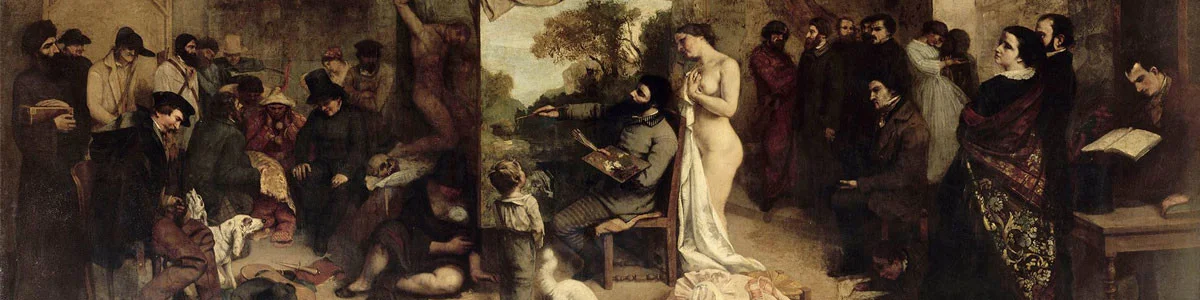
PRESENT AN ALIEN FROM OUTER SPACE with an illustrated time line of Western art—from, say, Theodoros of Samos to selected offerings from any museum of contemporary art. Ask the fellow if he can tell which end of the time line is the beginning. [It is not a trick question. We just do not know whether aliens read from left to right or the other way around.] If the frequencies along his optic nerves run as ours do, and if he has his wits about him, he will choose, with confidence, the contemporary stuff as the slime from which Theodore eventually emerged. Continue Reading
IN RESPONSE TO THE EARLIER POST, Art & Money, an astute reader writes to ask:
Perhaps conscientious and knowledgeable critics should try to explain the supply side of this equation, how art is produced to play a role in the continuing cycle.  How does it happen that a woman with no more talent than any teenage girl who draws pictures of rock stars becomes famous, wealthy, and sought by collectors and museums?  Who accomplishes this, and to whose benefit?  Is it for money, or is it that, as O’Brien says in 1984, the purpose of power is power?
Continue Reading
HERE I SIT WITH A HORRID LITTLE BOOK. Well, not so little at 300 pages but definitely unlikeable. Fine Art and High Finance by one Clare McAndrew was published this year by Bloomberg Press [yes, that Bloomberg]. Subtitled Expert Advice on the Economics of Ownership, it is a handbook on the global art trade meant for the financial sector. Dr. McAndrew explains:
The international art market is estimated to have turned over more than $60 billion in total sales of fine and decorative art and antiques in 2008, one of its highest-ever recorded totals.
Continue Reading
THE ARTS ARE AN ENDLESS SOURCE OF CHEAP GRACE. Like the ancient Celtic myth of Dagda’s cauldron, it is the pot that never empties. The most recent ladleful of pop spirituality is Dean Radinovsky’s Chapel Americana, a roughly 13 by 17 foot warehouse version of one of the sacred caves the artist had seen on a trip to Crete. Radinovsky completed his site-specific meditation space in 2008. His faux chapel is lined with formless abstract paintings, as vague and spacey as the word spirituality when it shows up in press releases. Continue Reading
PLEASE, NO MORE COMPLAINTS. Several readers have complained that the previous post, “The Artificial Artistic Self,” was unkind to Jane Culp. No, I do not think so. There is no reason to talk about art and artists with any greater delicacy than we use in talking about politics and politicians. Our only obligation is to try to say the right thing. Straightaway, I do not know Ms. Culp. She does not know me. She sent me her catalogue because my name in on the Bowery Gallery’s press list. Continue Reading
Subscribe To The Newsletter

Subscribe To The Newsletter

Join the Studio Matters mailing list for an occasional heads-up. Thank you.

You have Successfully Subscribed!

Premade image 14

Subscribe To The Newsletter

Join the Studio Matters mailing list for an occasional heads-up. Thank you.